Biodiversity of Bozevce 

Hi ! I’m Jules and I’m volunteering for GAIA organization for one year in Bozevce. I’m also a “naturalist”, meaning someone who studies animal and plant life, notably by going to the field to inventory biodiversity. During my stay here, I will share with you my observations of the biodiversity of Bozevce.

When winter comes, animals use different strategies to resist the cold and to find their food. Some species, notably birds, migrate towards south or towards lower elevation in order to find more food and warmer conditions. Others store fat, then hibernate until spring returns.

But some others species continue to be active troughout winter : it’s the case of fox (Vulpes vulpes), hare (Lepus europaeus), and to a lesser extent, badger (Meles meles).

In winter, foxes’ coats are denser, and they also have fur on their legs which allows them to resist the cold and snow. To feed, the fox will mainly hunt rodents and rabbits, using hearing to detect them under the snow or in their burrows. The fox will also hide some of its prey to consume it later.

Hares will also modify their alimentation and eat twigs, buds and bark when their usual food, grass and herbs, become scarce or unavailable. Badgers, on the other hand, don’t hibernate but greatly reduce their activities during winter. They will survive on their fat store made during autumn, and on earthworms, that they find while burrowing in the unfrozen ground.

These three species are present in Bozevce and we use camera traps to record them. A camera trap is a camera that is automatically triggered when something move in front of it. It’s a very useful device because it operate continually and silently, provide proof of species present in an area, and don’t disturb wildlife.

To finish on a less optimistic notes, climate change disturbs and modifies strategies of animals and plants to cope with winter: some species don’t migrate anymore, invasive species are better able to survive winter and to spread to new areas, food webs are disrupted and out of sync because plants bloom too early or insects emerge too early, some species even die from cold or hunger because less snow (which protect species that hibernate from cold) means more rain, which can block access to food when it freeze…

Biology students helped us with observing wildlife

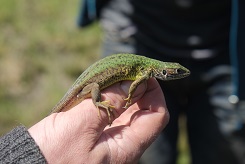
Look, I found a lizard! It must be a Lacerta viridis, with a blue and shiny head!” On normal days, you don’t hear sentences like this in Bozevce. But recently you could hear them a lot. Well, those two days were absolutely not normal when we had some biology scientists here doing research. A group from University of Pristina and University of Konstanz (Germany) spent some days here as part of a research seminar. This is the whole story:

Our property here is surrounded by nature. Now in late spring, everything is growing and blossoming and we sometimes get lost in belly-high green grass when we take a walk with our dogs. And of course, also all the wild animals now are out of their wholes, finished their winter rest and enjoy their life outside where they can find sun, warmth and food now.

For us it is quite important to know which kinds of animals are living at our place or close to it. Of course, on one hand, this is because of our personal interest – we appreciate the diversity here a lot and like to know which bird is singing here and who is digging a hole there. But, on the other hand, those wild animals are an important factor for the design of our permaculture property. Some animals can prevent damage of pests, some others can support growing of plants. Maybe one of the birds nearby likes to eat the caterpillars which are attacking our fruit trees at the moment. Maybe one of the insects we find can support plants in our garden. And maybe some little rodent likes to eat plants of which we have too much at the moment.

These are all little connections of the whole circle of permaculture and life here. If you know about them, you are a lucky person – but finding out about them takes time. “Observe and interact” is one of the twelve core principles of permaculture. We are trying our best to fulfill it, but after two years of working in this place the project is still at its very beginning. Sometimes, “observe and interact” the area outside the property moves a little bit into the background behind more important tasks like renovating the houses, woodwork and giving the garden a structure.

That’s why we were very pleased to host a group of biology students from University of Pristina and three scientists from University of Konstanz (Germany) here in Bozevce. Our friend Liridon Hoxha from the non-governmental organization “KEERC” (which stands for “Kosovo Environmental Education and Research Centre”) asked us if he could send one of his research groups here.

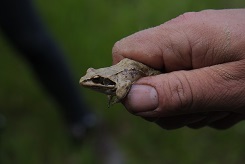
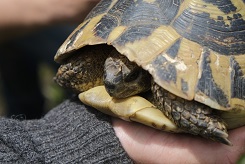
They came here in the beginning of May for two days and explored the reptiles and amphibians around here. We were invited to join their trips and to learn about those animals. Lizards, snails, tortoises, newts and salamanders – we found so many of them around. We learned how to differentiate different types of lizards and how to distinguish the gender.  – and to learn about everything else they knew because Karsten, Lorenz and Gregor from Konstanz could give us information about almost everything that was moving around our feet and flying in the sky. They distinguished 60 different types of birds at our place alone from hearing them singing! In the pictures, you can see that we found a lot of different reptiles and animals:

This visit was a big step forward for us in getting to know our surroundings better. This means that “observe” now is done more, so we will see how we can “interact” based on this new information. Anyway, no hurries, permaculture is a development which goes step by step. We were really happy to have this visit and are looking forward to eventually host similar camps in the future!

Antonia, May 2019