
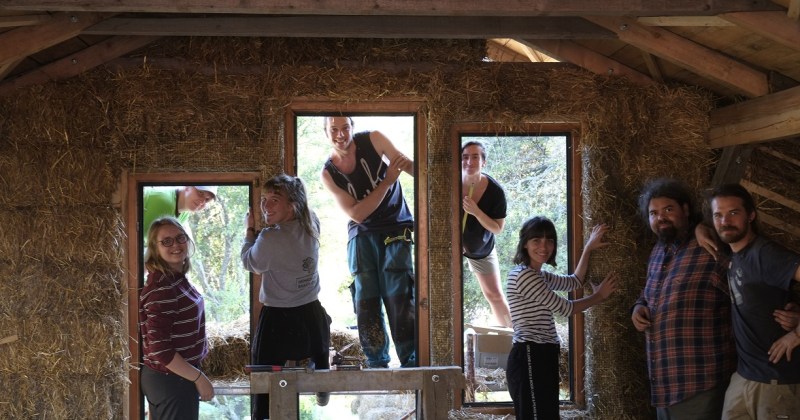

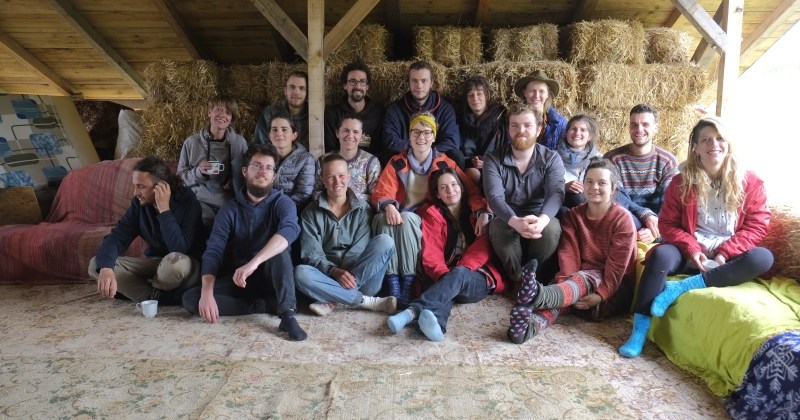
Almost two weeks ago, 12 volunteers from 10 countries flocked together in Bozevce for a 16-day workcamp in Kosovo.
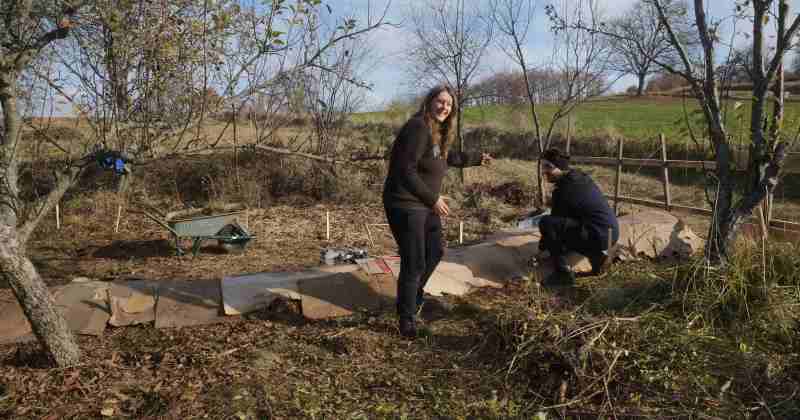
Being the first out of two workcamps in Bozevce, these weeks are dedicated to finalizing the second floor of a building on GAIA’s Permaculture estate through the means of natural materials and building techniques. This entails customizing straw bales to form solid walls, securing them with rebars and adding a layer of a cob mix (straw, sand, clay) to protect the straw walls with human power.
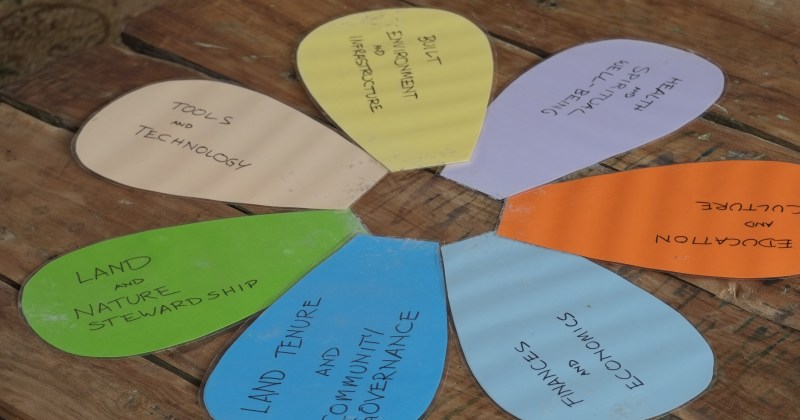
GAIA’s estate functions primarily on permaculture principles and ethics, one of the ethics is integral to this month’s workcamp: Fair Share – this means that you share goods and knowledge with another to improve both the collective and individual wealth of knowledge, well-being, but also that of our planet earth.


Since most of the participants were not familiar with the ethics and principles of permaculture, the first few days served to provide them with a concise, yet short introduction and how these were applied by GAIA in Bozevce. A solid understanding of permaculture is integral to the understanding why GAIA decided to follow natural building strategies and materials found within the close distance of their estate, instead of conventional tools and concrete to fill up the walls with. One way of getting participants familiar with the benefits of natural materials was by instructing them to come up with house building plans that include the new knowledge on building with natural materials. Not only did we learn about alternative heating systems and the use of thermo panels on roofs but also how participants from different cultural backgrounds came up with different solutions.
After the first few days of learning about permaculture, natural building and getting to know each other, we began our serious work on the roof on Monday. A regular day of work would start at 6:00 am when the early birds get up to rise with the sun. Others would gather around the beautifully hand-made wooden table around the tree soon afterwards to take their breakfast until 8:30 am. The work day would start at 9 am after a short briefing about the work schedule of the day. The day would be divided into 4 working sessions with coffee, water and cookie breaks as well as lunch and dinner in between of them. Given the fact, that the temperatures gradually rose to almost unbearable 40 degrees – we adjusted the hours in the second week to begin earlier in order to prevent our bodies from smoldering in the scorching midday sun.
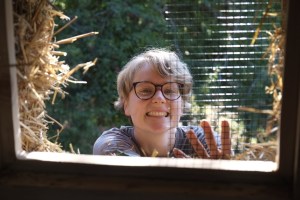

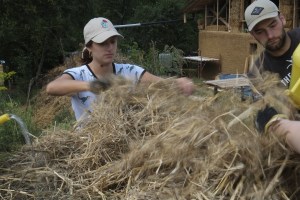

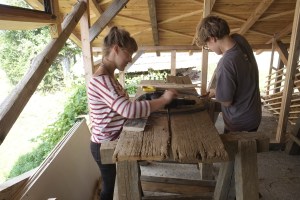

In the first week, work mostly set up the straw walls and fixed them with nets. This entailed a sequence of different tasks ranging from setting up the scaffolding around the facade of the building, cutting straw bales and fitting them into the wall constructions, plugging wholes with extra straw and flattening out the walls with blanks and strong arms. We mostly work in different groups throughout the day’s working shifts so that every person did not feel stuck in a task that they did not enjoy. Overall, this strategy retained the enjoyment of work task but also ensured that each person was able to learn how to conduct the different working tasks. Without labeling the strategy as a way of practicing Fair Share, it also aligned with the permaculture ethics.
On several days, the camp was visited by neighbours and KFOR soldiers who expressed their interest and curiosity in what we are doing in Bozevce. For most locals, building in this manner is not new to them but part of an old traditional way of resource efficient construction work. However, the fact that building this way requires more human power and stretches the duration of the building process, if one does not have enough helping hands, most of them have been opting for concrete as the main building resources in the region. Despite this trend, we all agree that using straw for wall insulation remains the single most resource efficient material in the area that respects environmental boundaries and climate stressors that come along with fossil fuel industries producing conventional house building materials.
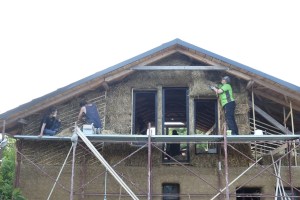


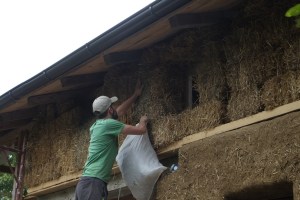

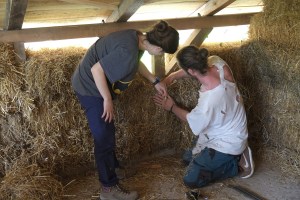
For the participants, the workcamp has been a unique opportunity to learn beyond the beaten path of house construction but also to disconnect from their busy everyday lives. Each of them readily adapted to the surroundings of the estate and the specific living conditions of Bozevce. One might conceive of the idea to put down mobile phones and not having the possibility to escape to big city life as uncomfortable restrictions to how they usually spend their time, but actually function as enablers to become more aware of the natural and social environment by living minimally. Reducing one’s possibilities of how to spend their free time such as surfing the internet, going out for drinks or enjoying other forms entertainment has both bounded the group together and enabled each of us to reconnect with the natural environment and bodily senses. Put differently, GAIA’s workcamp teaches us in many ways of how to feel more with less.


 Dandelion (Taraxacum officiale): Dandelion grows everywhere in spring. The plant is up to 25 cm high, the flowers are yellow and the leafs are green and look a little bit like teeth. That’s where the name comes from; it means “tooth of lion”. These leafs are very tasty in salads when they are young. The roots are eatable as well, and from the flower you can make a delicious dandelion “honey”.
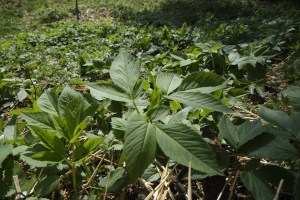 Ground elder (Aegopodium podagraria): This plant covers the ground in shady areas which get some water from time to time. Its leafs are always arranged in a group of three and the flower looks like elder, which means that it is white and it is arranged in a creeping with white umbels.
 ll leafs which occur more often near the top of the plant on small branches. The flower is pinkish-purple. It gives your food a lovely Mediterranean taste.
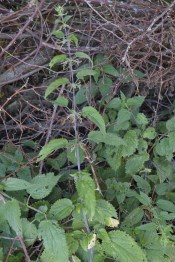 Stinging Nettle (Urtica dioica): This is a plant almost everybody knows and most of us hate it: Because it hurts you, as soon as you touch it! The leafs are dark green and in a triangular shape and the plant is up to 1.50 m high. The young leafs which do not sting yet are very good in salads and once the plant gets older, you can use it like spinach. But nettle is not only tasty, you can also make a very good fertilizer for your garden with it: Fermented for two or three weeks in water and then sieved, it becomes a good treat for your tomatoes, beetroots and other plants.
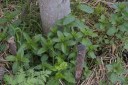 green leafs and all have this typical mint smell. They grow up to 70 cm high and the blossom is slightly violet. A tea from it helps against digestion problems and against a cold.
 and the “edges” which let it look like nettle a little bit. Lemon balm can grow up to 80 cm high and it prefers cool and shady places. The blossom is white-blue, small and not very spectacular. The tea of the leafs is good for treating nervous complaints of stomach, intestine and heart. It is anti-depressant and oil of lemon balm can help to heal wounds.
 they are red-violet and they have darker stripes and five parts. The leafs are parted into five sections. This plant is marvelous as a tea against colds and it strengthens the immune system in general.
 Thyme (Thymus vulgaris): This plant you probably know from pizza. The Italian kitchen is famous for using it which is not astounding since this plant prefers the hot Mediterranean climate. It often grows on rocky places and dry grassland. Thyme basically has tiny leafs and tiny flowers which can appear in different colors. It can be recognized by its characteristic smell. In tea, it helps against colds and in oil it is antibacterial. So if you plan to make your own toothpaste, thyme gives you a good smell and a good outcome in the same time. And of course, it tastes very good on pizza!
 Rue (Ruta graveolens): This perennial plant grows up to 50 cm high. It has yellow flowers in a kind of little “crown” at the top of the plant and it has small and long leafs which are arranged to little “hands”. Rue prefers a rocky and sunny surrounding. It helps against blood pressure and vein problems as well as against epilepsy. Furthermore it is good to have one in your property if you have animals since fleas don’t like its smell and so your animals will be free from them.
 Chamomile (Matricaria chamomilla): This little flower is actually a wonder-healer. The blossom is white with a pretty big and outstanding yellow “ball” in the middle, the leafs look like tiny little feathers. The plant is little itself, it can grow up to 40 cm high, but most of the time it covers the soil on the corner of paths. So watch out, maybe you are stepping on a treasure! The smell is strong and aromatically, and the tea out of the flowers as well. It helps against multiple diseases, first cold, but also womanlike diseases, it brightens up your mood in general and it helps your digestion system. You can also make oil or crèmes for the skin from it and this will calm down irritated skin.
 Plantain (Plantago sp.): This is another plant we are often stepping on and we should pay more attention to: Planatain has either big or thin and long leafs, depending on the type of planatain, but they have in common that each leaf has some strong little strings crossing it in a distance of 2-5 mm. The leafs cover the ground, while the blossom grows up on a long steel and looks cylindrical, up to 7 cm long and covered with little pink or white flowers. Tea of the leafs and the flowers helps against cold, chewing the flowers helps against toothache. If you have a stitch of a bee, you rub a leaf between your fingers until the juice comes out and you put the juice on the stitch. The swelling will disappear.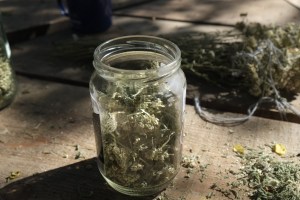



 Alex, June 2019









 Permaculture as a Path to Peace