


Everyone knows orchids. Thanks to their beautiful flowers, bright colors and sweet fragrances, orchids have become the queens of ornamental plants, perfect for embellishing a room. But who knows that there are 28,000 species of orchids in nature, making them one of the most diverse plant families? Before conquering our living rooms, orchids first conquered the world. They are found on all continents, and in all habitats. They have conquered mountains, meadows, wetlands, forests… It is in the tropics that we find the greatest diversity of orchid species, where 95% of known species live. Nevertheless, although more discreet, they are very present and diversified in Europe. Around 500 species are present in Europe. In Kosovo, 33 species are known to date, but there are probably many more. Indeed, the diversity of the neighbouring countries is double (66 species known from Serbia and 68 from Albania).


The Greater butterfly-orchid Platanthera chloranha and the white helleborine, Cephalantera damasonium, two orchids with not very flamboyant colors. Both were observed in Bozevce
Their lifestyles are very varied. Most orchids are not directly rooted in the ground: they attach themselves to the trunks and branches of trees or to other plants thanks to their aerial roots. They are said to be “epiphytes”. Others are lianas, or grow on the ground, like most of European orchids. Some are parasites and take their food from fungus or from the roots of other plants. This is the case of one of the species observed in Bozevce, the bird’s-nest orchid (Neottia nidus-avis). As it does not perform photosynthesis (the way plants “feed” normally, using solar energy), this species is not green, but yellowish, and only its flowers appear a few weeks in the year to ensure its reproduction.
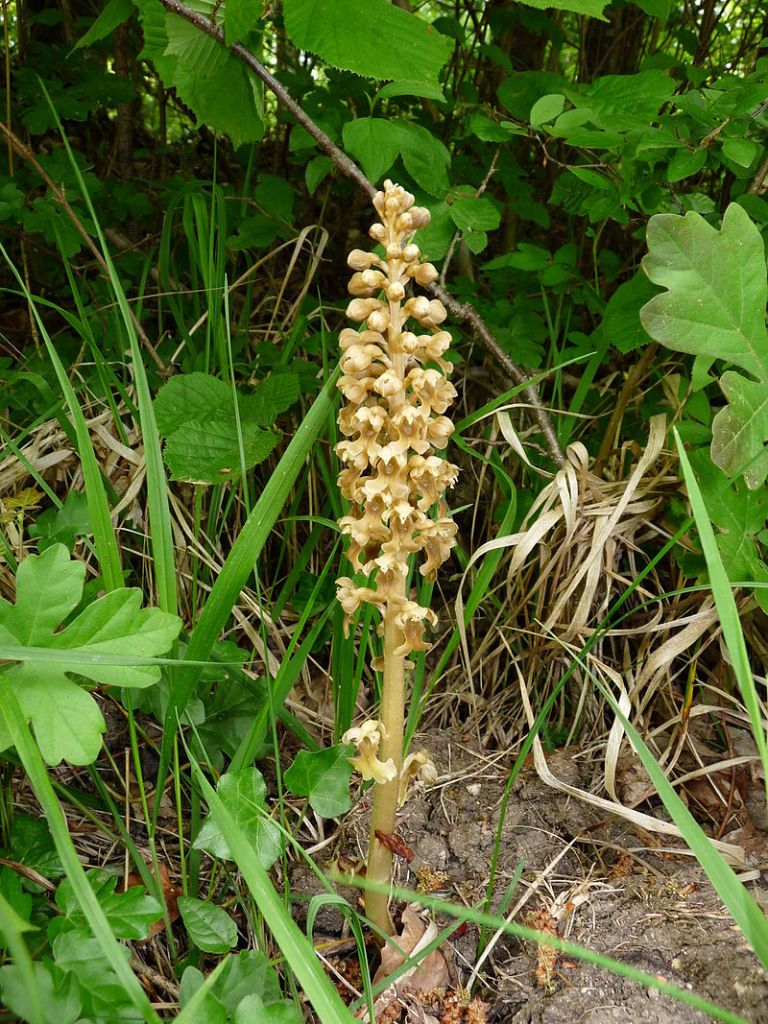
Some orchids are therefore parasites, but all are also mutualists: orchid roots host fungi that are essential to ensure the germination of the seed and the supply of water and minerals to orchids.
Other small organisms are essential to orchids: insects. To ensure their reproduction through pollination, orchids have developed flowers with very varied shapes, sizes and smells, in order to attract specific insects. It is this process of coevolution between insects and orchids that has resulted in the enormous diversity of orchids that we now know. Thus, some orchids will have large white flowers with long spurs to attract moths with long proboscis, others have colorful flowers that imitate the females of certain wasps or bees, and others will have small green or white flowers with a repulsive odour, which will attract tiny flies.
The diversity of size is also impressive: some orchids measure only a few millimeters while some orchid vines can reach 20 m long. The giant orchid, Grammatophyllum speciosum, can weigh more than 1 ton!
Apart from their importance as ornamental plants, orchids are also found in the kitchen… Indeed, vanillas (a hundred species are known) are vine orchids growing in tropical forests!

Unfortunately, many species of orchids are also threatened by the development of human activities. The disappearance or modification of their natural habitats as well as the collection of orchids in the wild are among the most serious threats to orchids. Therefore, orchids are protected in many European countries and the international trade of wild orchids is regulated by the Washington Convention (CITES).


Orchids flowers can have very diverse shape. Here the Lizard orchid Himantoglossum calcaratum and the Bug orchid Anacamptis coriophora, both present in Bozevce
In Kosovo, orchids are little known and only one species was assessed in the recent Red Book of the Vascular Flora of the Republic of Kosovo. Assessed as “near threatened” in Kosovo, Gymnadenia friwaldii is also the only protected species in Kosovo.
Although I am not a botanist, I know a little bit about orchids. These iconic and colorful species are easy to spot and identify.
In Bozevce, 12 species were identified in 2024. This beautiful diversity reflects the preference of many orchids for calcareous soils, like those of Bozevce.
The orchids observed differ in size, color, or even their living environment. Some like meadows (the lady orchid, Orchis purpurea, the green-winged orchid, Anacamptis morio), others prefer rocky areas or with shorter vegetation (the bug orchid, Anacamptis coriophora, the woodcock bee-orchid, Ophrys scolopax) while others live on the edge of forests (the Greater butterfly-orchid Platanthera chloranha, the white helleborine, Cephalantera damasonium). The strange Lizard orchid Himantoglossum calcaratum can reach 1 m high while the discreet burnt orchid Neotinea ustulata does not exceed 10 cm. Some are not very colorful, with white or yellow flowers (the Greater butterfly-orchid and the the white helleborine) while others have beautiful pink hues (the pink-butterfly Orchid, Anacamptis papillionacea, the pyramidal orchid, Anacamptis pyramidalis).


The woodcock bee-orchid, Ophrys scolopax, the burnt orchid Neotinea ustulata and the pink-butterfly Orchid, Anacamptis papillionacea were all observed in Bozevce’s grasslands
This beautiful diversity of orchids suggests a rich diversity of plants. We hope to host some botanists this year to help us learn more about the plants living in Bozevce…
 Permaculture as a Path to Peace