
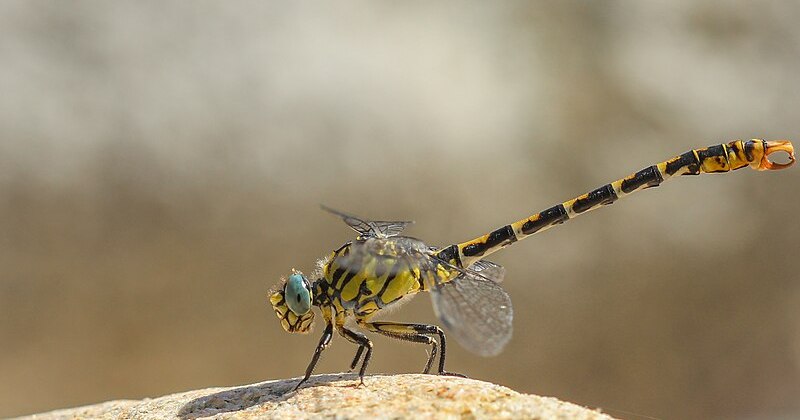

Since their appearance 3 million years ago, dragonflies have been patrolling the skies on every continent. Capable of great aerial feats, dragonflies can move at an amazing 55 km/h, hover like a helicopter, fly backwards like a hummingbird, fly straight up, down and on either side. Easily spotted, these animals are formidable predators, aquatic in the larval stage then aerial and excellent flyer in the adult stage, which led a French scientist to say that “these insects begin their lives as combat swimmers and end them as fighter pilots”.
Their preys are diverse: the larvae feed on aquatic insects, particularly mosquito larvae, as well as tadpoles and small fish for the larger species. The adults capture flying insects, and also feast on mosquitoes.
Dragonfly larvae, which have gills and are very different from adults, need water to develop. Thus, adults are most often seen near bodies of water. Some species prefer stagnant water, such as ponds, lakes, and marshes, while others appreciate rivers, streams, and other areas of running water. However, dragonflies can be found far from water, because they are able to travel great distances to feed, and some species are even migratory! Thus, at the end of spring or the beginning of summer, when the wetlands of northern Africa or southern Europe dry up, some species travel thousands of kilometres north. They then reproduce there, die, and it is their descendants, when autumn comes, who will make the return journey.

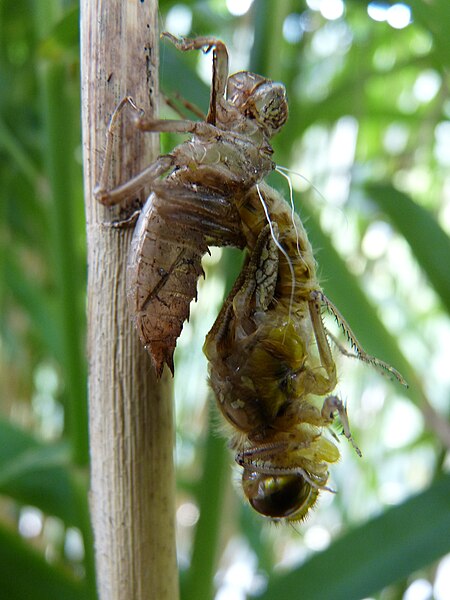
Dragonfly larva (Virgile Kuhn, CC-BY-NC-SA) and metamorphosis of a dragonfly emerging from its exuvia (Onésime, CC-BY)
Odonata (the scientific name for dragonflies) are recognizable by their two pairs of transparent wings, their elongated bodies and their large compound eyes that allow them to effectively hunt their prey.
The order of Odonata is divided into two groups: true dragonflies, or Anisoptera, hold their wings flat and away from the body when at rest, and are often more massive, while damselflies, or Zygoptera, hold their wings folded at rest, along or above the abdomen.

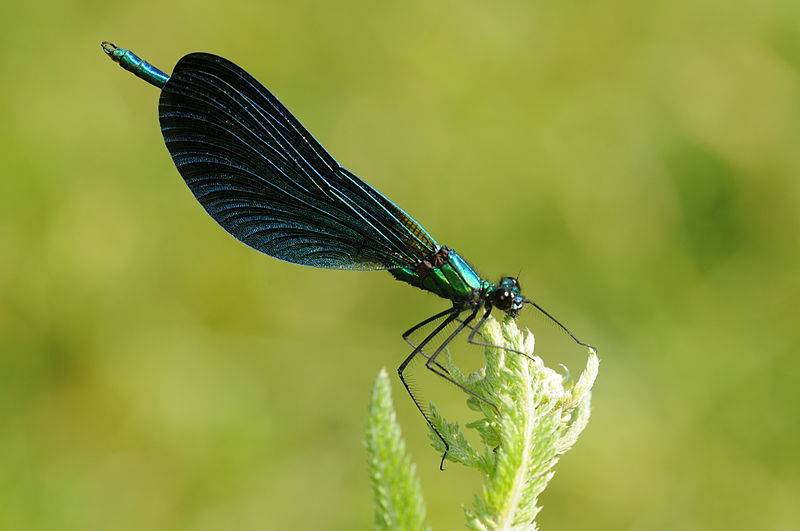
An anisoptera, the Small pincertail (Onychogomphus forcipatus – Simon Thévenin, CC-BY-SA) and a Zygoptera, the Beautiful demoiselle (Calopteryx virgo – Zeynel Cebeci, CC BY-SA 3.0). Both species were observed along the Perlepnicë river in Bozevce
There are 6,400 species of dragonflies in the world, 143 in Europe… and in Kosovo? Kosovo is considered as one of the most understudied countries in Europe regarding dragonfly fauna. 47 species of dragonflies are known from Kosovo, but more species remain to be found, knowing that the number of species in neighbouring countries is around 60 (57 in Albania, 62 in North Macedonia, 63 in Serbia and 67 in Montenegro). Among these 47 species, 12 are included in the Red Book of Fauna of the Republic of Kosovo. 4 are classified as Near Threatened, 1 as Least Concerned (Not Threatened), and 7 species as Data Deficient (not enough data to know is these species are threatened or not). These 12 species are also protected in Kosovo.
Wetlands (ponds, rivers, bogs), where dragonflies breed, are fragile habitats that have been and continue to be subject to numerous modifications, destruction and pollution over the past centuries. Large scale land conversion, canalisation of rivers, construction of dams and reservoirs, drainage, water pollution, eutrophication and climate change are some of the numerous threats driving the decline of dragonflies.
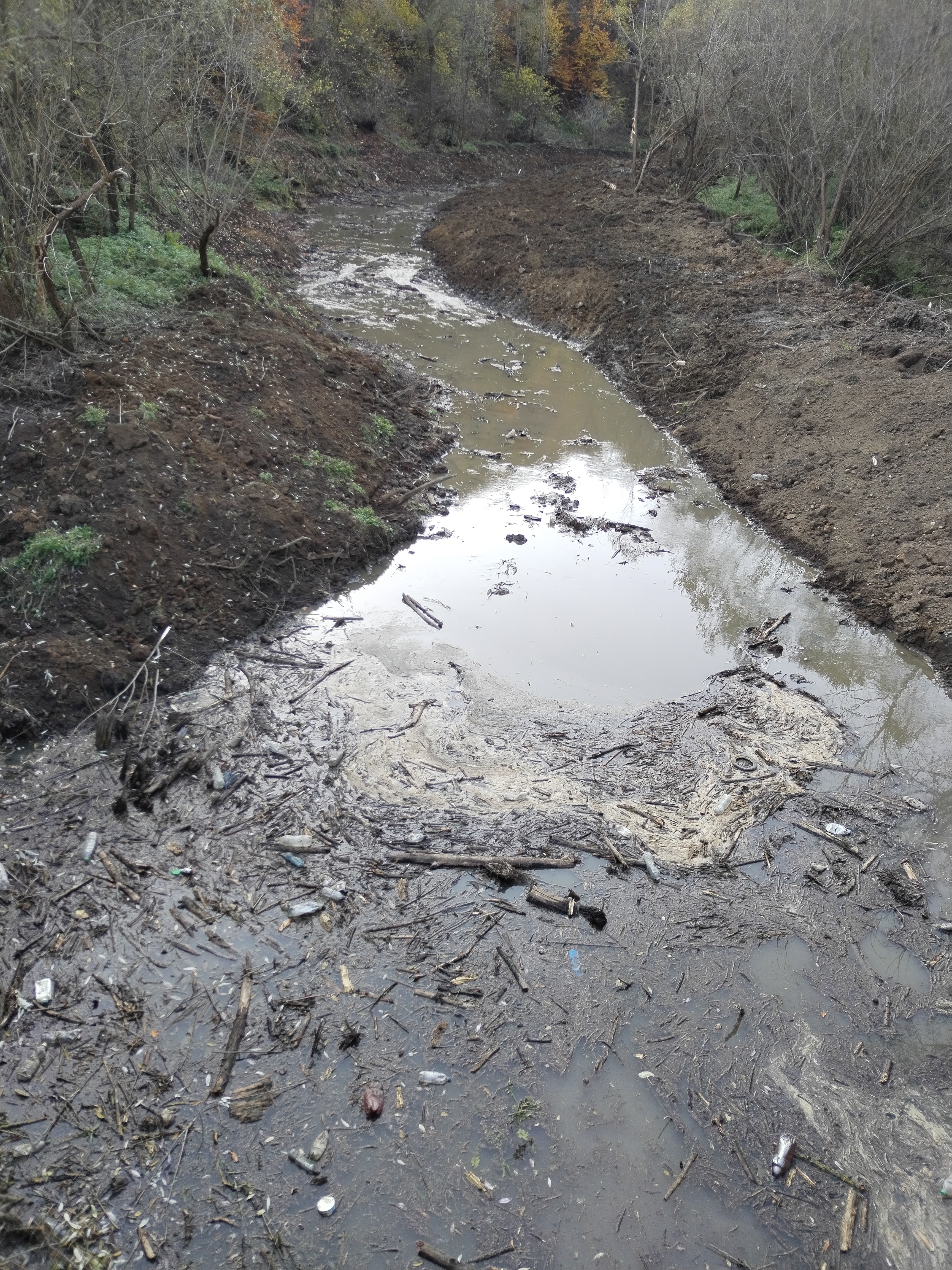
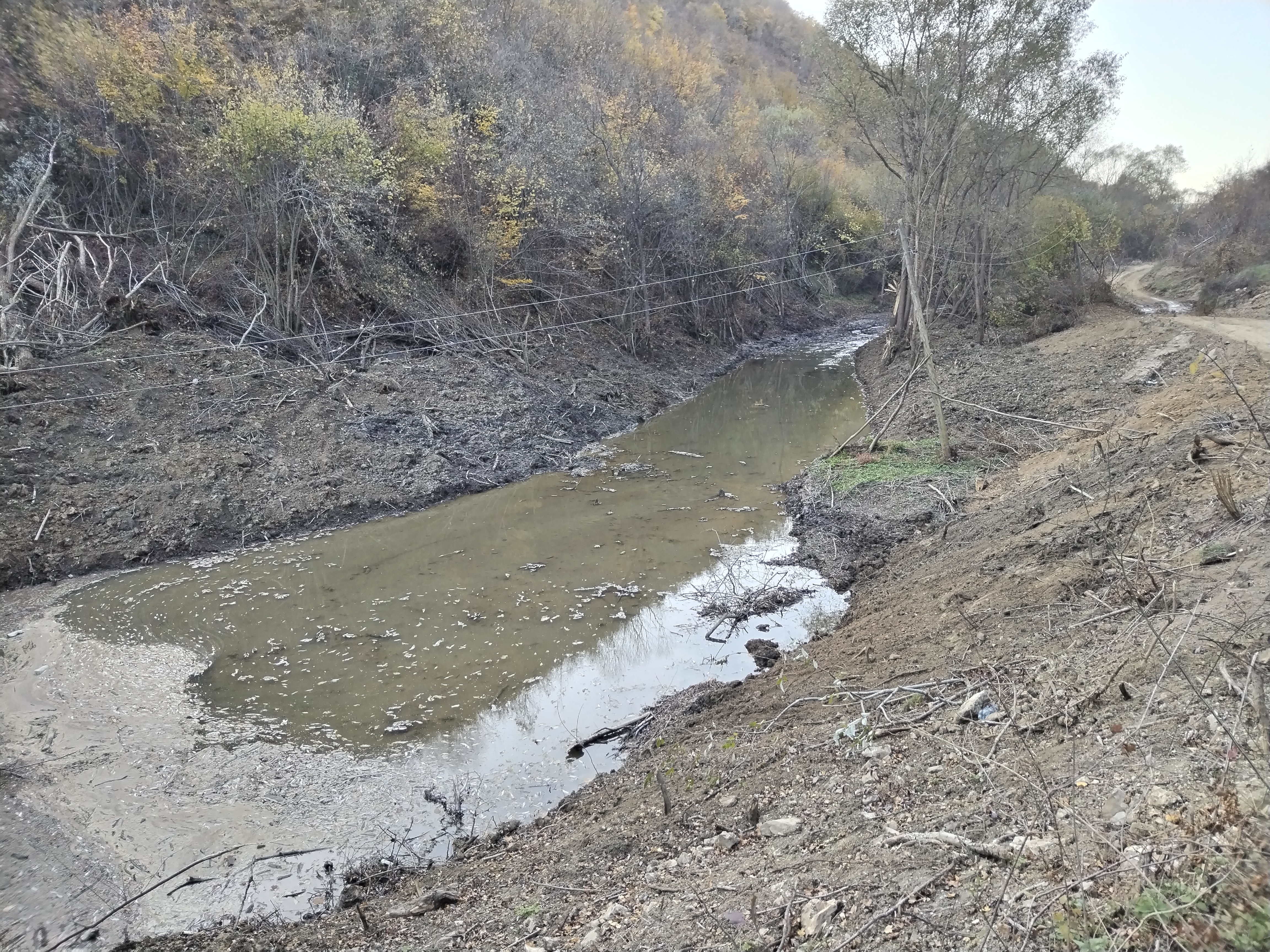
Pollution and modification of their habitats are two importants threats for dragonflies, even in Bozeve
Many species of dragonflies have small distributions and are specific to certain habitats such as temporary ponds or brooks. Dragonflies are frequently used as indicators of environmental and landscape diversity and quality, because their sensitivity to habitat quality (e.g. water chemistry, river structure), their amphibious and short life cycle (they react rapidly to changes in their habitats) and the relative ease of their identification make their study well suited to assess environmental change.
Let’s now talk about dragonflies’ fauna of Boževce!
In Boževce, open water is quite scarce and so dragonflies’ habitats too. Dragonflies were observed along watercourses (stream and streamlets), around two ponds (one being in our garden) … and far from the water, in meadows and fields, where dragonflies go to hunt insects.

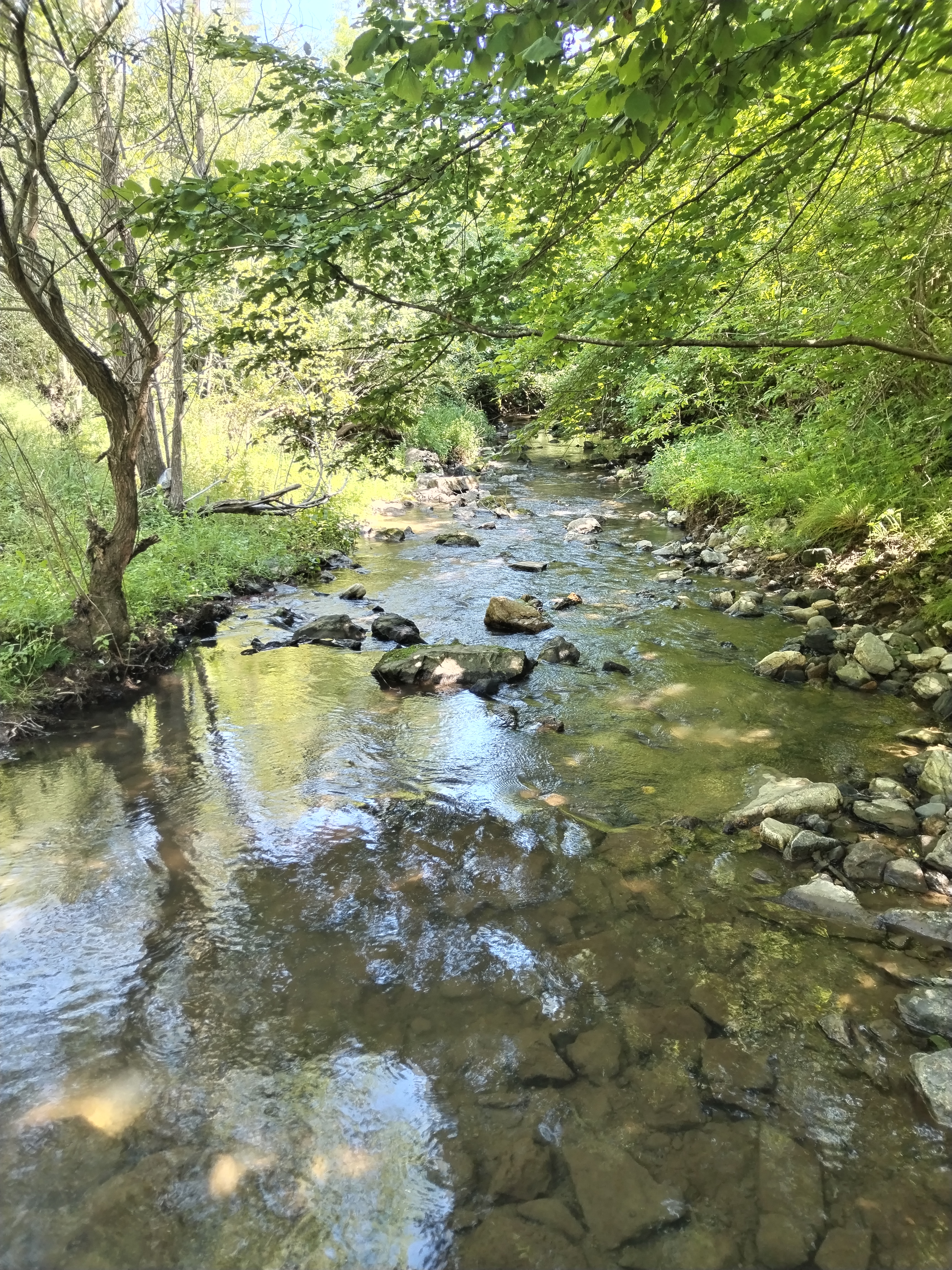

Habitats of dragonflies in Bozevce : streamlet, Perlepnicë river and pond
17 species were observed: 11 true dragonflies (Anisoptera) and 6 damselflies (Zygoptera). 7 of these species are linked to still water and were observed around the ponds. The 10 remaining species are linked to streams and other watercourses. Even if there are multiple streamlets in Boževce, most of them are small, and it’s likely that most of these species breed in the river that was destroyed in September 2024… Of these 10 species, 7 are threatened and protected. The Sombre Goldenring (Cordulegaster bidentata) and the Balkan Goldenring (Cordulegaster heros) are two similar species, whose larvae develop in small, fast-flowing, shaded streams. Both are considered Near Threatened in Kosovo. This is also the case for the Common Clubtail (Gomphus vulgatissimus) and the Small Pincertail (Onychogomphus forcipatus), two species that prefer sandy, sunny areas of streams. Another 3 species are classified as data deficient, due to the lack of data that does not allow to define their conservation status in Kosovo. The Southern Skimmer (Orthetrum brunneum) is a pioneer species which favours the same habitats as Gomphus vulgatissimus and Onychogomphus forcipatus. Finally, the Eastern Spectre (Caliaeschna microstigma), whose distribution is limited to the Balkans and Turkey, and the Balkan Emerald (Somatochlora meridionalis) are species of fast-flowing and shaded streams.


Scientists sometimes need to catch dragonflies to identify them. These manipulation are not damaging dragonflies but should be carried out only when necessary and by experts. Two rare species present in Bozevce : Sombre Goldenring (Cordulegaster bidentata ; left) and Eastern spectre (Calliaeshna microstigma; right)
Another species, the Large Red Damselfly (Pyrrhosoma nymphula), which prefer still water and was observed in large numbers around one pond, is also included in the red book as Data Deficient and is protected in Kosovo. Thus, 8 of the 12 species of dragonflies protected in Kosovo are present in Boževce!
Dragonflies are good indicators of habitat quality and environmental health. Before the destruction of the Perlepnicë river, it’s therefore likely that Boževce habitats were very biodiverse and healthy, not only for dragonflies, but for all the other organisms that thrive in and along rivers, and for people that are drinking water from this river. Thus, it’s crucial to stop the destruction of Kosovo’s rivers, and to protect these vital habitats!
Sources:
Boudot J.-P. & Kalkman V.J. (eds) 2015. Atlas of the European dragonflies and damselflies. KNNV publishing, the Netherlands.
Dijkstra K. D., Schröter A. & Lewington R., 2020. Field Guide to the Dragonflies of Britain and Europe. Second Edition. Bloomsbury Publishing, London.
Ibrahimi H., Gashi A., Rexhepaj D., Zhushi Etemi F., Grapci Kotori L., Fehér Z., Bino T., Šerić Jelaska L., Mesaroš G., Théou P., 2019 – Libri I Kuq I Faunës, Së Republikës Së Kosovës
Kalkman V.J., Boudot J.-P., Bernard R., Conze K.-J., De Knijf G., Dyatlova E.S., Ferreira S., Jović M., Ott J., Riservato E. & Sahlén G., 2010. European Red List of Dragonflies. Office for Official Publications of the European Union, Luxembourg, 29pp. Vinko D., Kulijer D., Etemi F. Z., Hostnik M., & Šalamun A., 2020. The first systematic survey of the dragonfly fauna of Kosovo. International Dragonfly Fund: Report, 2020 (147), 1-50.
 Permaculture as a Path to Peace