

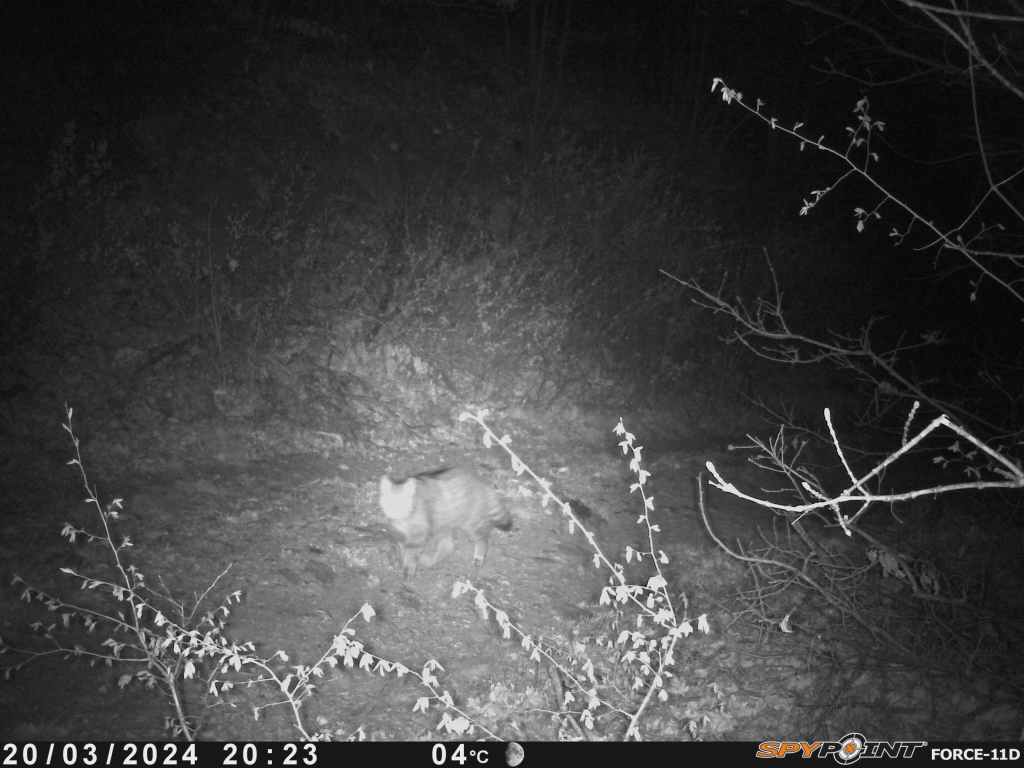
The photo trap is definitely a very practical tool. From March 17 to April 7, I left my photo trap on a path in the West of Bozevce, far from any houses. And the result exceeded my expectations: Fox, Badger, Wolves, Stone Marten… and Wildcat! In total, we took pictures of seven species of mammals and of three species of birds! Even far from any village, humans are still there: motorbikes, hunters and dogs were also using the path. We were hoping that the Wildcat would be present in Bozevce, but after 7 years of GAIA being here, this is only the first time we have managed to prove it! This very elusive species was photographed on 6 different nights, so this path seems to be part of its territory. But who’s the Wildcat?


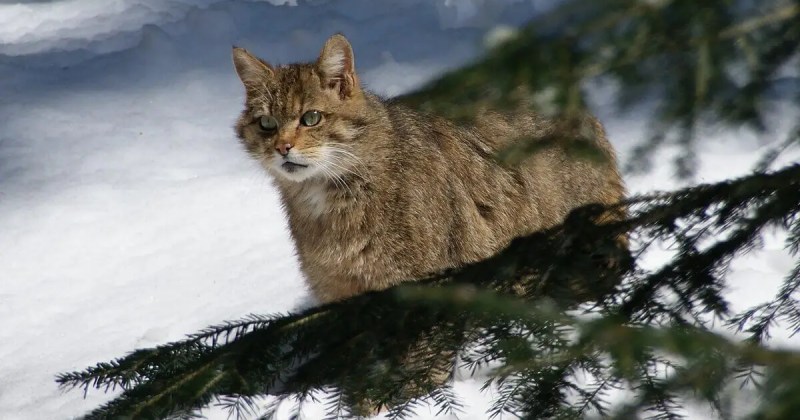
The European Wildcat (Felis silvestris silvestris) is an elusive host of our forests. He can be found in a wide range of habitats, ranging from forested areas, thickly vegetated scrub and open rocky areas, but he avoids areas where people are concentrated. Wildcats are extremely shy. They avoid approaching humans. Wildcats live alone in a territory whose size can vary depending on resources (availability of food, etc.), the presence of quiet places, as well as the season. Females generally have a much smaller territory than males. According to estimates, these territories can be 2 to 5 km² for females and reach 12 km² for males. It’s a strict carnivore, its diet mainly consisting of rodents and occasionally hares, birds and amphibians.
The Wildcat is very difficult to differentiate from the domestic cat. He is on average bigger and stouter. It has also longer fur and a shorter non-tapering bushy tail. Finally, its tail is ringed black, and it has a dark dorsal band.
Some others pictures from the camera trap :


Despite this, the European Wildcat… is not the ancestor of our domestic cats! This “honour” goes to the African Wildcat (Felis lybica). The first domestications took place 8,000 to 10,000 years ago during the Neolithic in the Fertile Crescent, a time corresponding to the beginning of cereal cultivation and the accumulation of reserves likely to be attacked by rodents. The African Wildcat became then for Man a useful auxiliary suitable for domestication.
During antiquity, European Wildcats occupied all western, central, and southern Europe. The elusive nature of the animal has fuelled fantasies far removed from reality. The little feline has long had a bad reputation as a ferocious beast. For centuries, numbers of wildcats have declined due to deforestation, but also because of these false beliefs, wildcats were hunted as a pest and for their fur.

Now protected throughout Europe, the Wildcat is making a cautious return to certain forests where it had disappeared. However, the situation is different in Kosovo. Here, the wild cat never disappeared, but its population is not doing so well. The wildcat is in decline and is classified as Near Threatened in Kosovo. The wild cat is threatened by the loss, degradation and fragmentation of its habitats, the forests. Road collisions and hybridization with domestic cats are two other threats to Wildcats.
The presence of this species is an indicator of the overall quality of the habitat. Its conservation involves the protection of its habitat, the forest. And by protecting the forests that are home to Wildcats, we protect all the biodiversity that lives there. So why not in Bozevce?
 Permaculture as a Path to Peace