
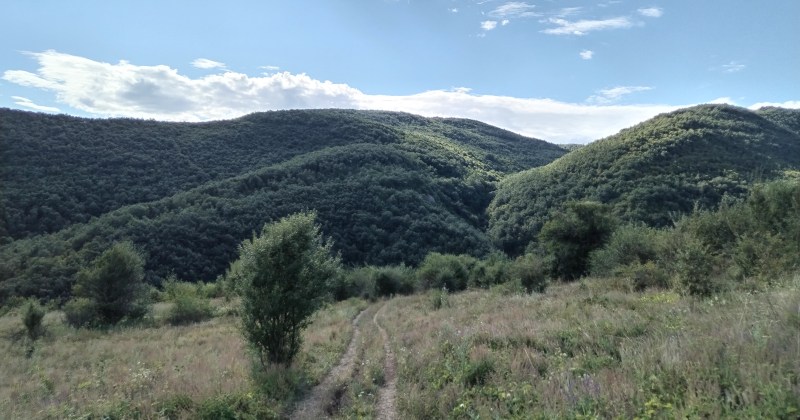

Friday March 8. It’s 6:40 a.m., I just got up, and I’m hesitant to go running, because the day before, my knee was hurting. In the end, I’m going anyway. And I wouldn’t regret it. While I am on my way back, on the ridge, I see 4 shapes on the path, 150 m away from me. For a few seconds, I think they are wild boars. But I quickly realize that they are wolves! I don’t stop running and approach them. One disappears into the forest, then two others. The last wolf stays staring at me until I am only 30 m away from him. Then, he also disappears in the forest.
What a magical moment! For the nature lover that I am, seeing wolves is an incredible gift that they gave me. I was then asked if I had been scared. It was the opposite. I was euphoric, with tears in my eyes, because of joy. I have immense respect for this fabulous predator and will now explain you why we should not fear and why we should protect wolves.


Historically present throughout Eurasia and all of North America, the wolf, victim of persecution and a bad reputation (the famous Big Bad Wolf of the stories did a lot of harm to the European wolf), disappeared from many territories during the 19th and 20th centuries. It completely disappeared in Japan and declined sharply in India, USA, and Europe.
Wolves have always been at the heart of human fascinations and is represented in many cultures. They have often been the object of cults, superstitions, and persecutions. In most of European and North American legends, the wolf is a deceitful and merciless predator, and sometimes even a man-eater. However, most of these legends and stories, are based on misconceptions, not supported by scientific evidence.


Werewolves and the Big Bad Wolf, two representations of the wolf as a man-eater
In Europe, the wolf is not considered to be dangerous for humans by scientists. There has not been a single verified fatal wolf attack on humans in Europe in the last 40 years. Scientific evidence has shown that wolves do not treat humans as prey, and fatal encounters are exceptional. Most fatal attacks are caused by rabid wolves, in countries where this disease is still present.
Predation on livestock has been the main cause of wolf persecution throughout history and is currently the main source of conflict between wolves and people in Europe and in most of its global range. Wolves mainly kill vulnerable wild ungulates. Since domestic livestock is vulnerable when unprotected, the wolf follows its natural tendency and kills them. However, the impact of wolves on livestock is very small: in the European Union (numbers are difficult to find for Kosovo), wolves eat approximately 50 000 sheep and goats annually. However, there is 60 million sheep in the EU, meaning they eat just 0.065% of sheep! Moreover, areas with continuous wolf presence (like Kosovo) experience lower depredation levels compared to regions where carnivores disappeared and then returned within the last 50 years. The frequency of livestock damage is influenced by factors such as the abundance of natural prey, landscape features, and the implementation of protective measures. In fact, effective tools exist to protect livestock and are the solution for coexistence. Scientific studies have shown that shooting wolves to protect livestock is ineffective and counterproductive.


Wolf (Canis lupus) (Mas3cf – CC-BY-SA) and its repartition in the world
That’s it for the bad reputation of wolves. And why should we protect them? If you need more reasons that just the fact that wolves are very intelligent, social, and beautiful animals, wolves also play a key role in maintaining healthy ecosystems and biodiversity. As top predators, they regulate deer and wild boar populations, who, when they are too numerous, tend to eat all the young trees. By selecting the most vulnerable prey, such as sick individuals, wolves can also reduce the incidence of diseases. Their presence ensures that our ecosystems are balanced and in good condition with numerous animals and plants thriving.
Since I wrote this article, I have seen wolf one more time while running (this time, one individual), and we get some pictures of wolves with our camera trap.


I hope that wolves will continue to haunt our forests for a long time…
 Permaculture as a Path to Peace