
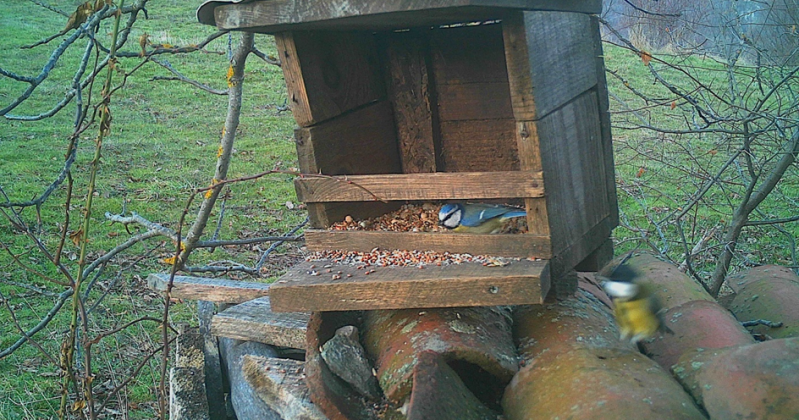

Winter is a harsh season for birds: frozen ground and snow prevents birds from finding their food. Moreover, modern agricultural techniques tend to reduce the food resources available (seeds left standing in crops, berries in shrubs, etc.). Therefore, feeding birds can help them get through the winter.

Winter starts quite strong here: 20 cm of snow at the end of November (which melt quite fast), and since then, frost almost every morning (except this week). Therefore, we decided to install 4 birdfeeders, to offer food to the birds, but also to study them. In fact, bird feeders are good opportunities to have a close look at birds that are usually difficult to see.
When done incorrectly, feeding birds can be harmful to them. Therefore, some precautions should be taken:
– Feeders and waterers should be in an open area, away from walls, bushes and side branches in order to avoid easy access to predators (cats, martens, etc.).
– Birds compete for food, so providing them with more birdfeeders can loosen competition and help less aggressive species.
– Big gathering of birds means more opportunities for disease to spread. Cleaning feeders and waterers is therefore useful to reduce the risk of disease spread.
– Regarding food, each species of bird has specific needs. It is best to choose seed mixtures, which will suit many species regardless of the size of their beaks. Black sunflower seeds, very rich in lipids, are particularly suitable. You can also give them seasonal fruits (apples, pears, grapes) as well as cracked corn and peanuts (unroasted and unsalted). Milk and bread should be avoided because birds cannot digest them. Leftovers are also non suitable for birds as they are often too salty, too sweet, or too cooked for their body.
– Finally, don’t forget to give them water
Even after taking all these precautions, feeding birds can still have impacts. Some species take more advantage than others of birdfeeders and this can modify the balance of competition. One striking example comes from Great Britain, where millions of people feed birds. Great tits (Parus major) and blue tits (Cyanistes caeruleus) are among the most regular and abundant passerines visiting European feeders: they take full advantage of this additional supply of food, which allows them to survive better during winter and then to reproduce more, thus contributing to a sharp increase in their populations over the past fifty years. During the same period, Marsh Tits (Poecile palustris) and especially Boreal Tits (P. montanus) declined strongly (-78 and -92%) in Great Britain. According to several studies, this opposite trend is linked to increased competition from Blue and Great Tits, two species which are favoured by feeding.
So, should we stop feeding birds? Difficult to say, as some other studies show that the population of many species are increasing thanks to bird feeding. What is pretty sure, is that birds should be fed only in winter (mi-November-March). Feeding birds during the breeding season could increase the risk of disease transmission, increase predation, generate physiological disturbances, and modify the balance of competition.
After all this theory, let’s talk about our feeder in Bozevce.
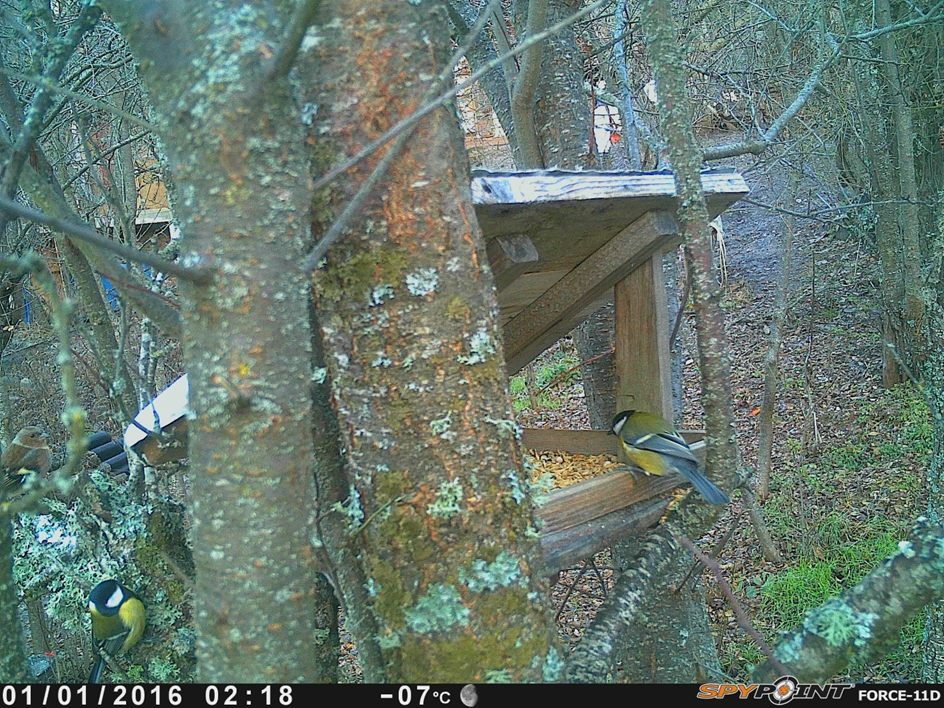
From now, we have observed 9 species! Great Tits (Parus major) are clearly the most numerous, followed by Tree Sparrows (Passer montanus). Chaffinches (Fringilla coelebs) are also quite frequent. Eurasian Bullfinch (Pyrrhula pyrrhula), Great Spotted Woodpecker (Dendrocopos major) and Marsh Tit (Poecile palustris) were only observed once. Finally, Eurasian Jay (Garrulus glandarius), Blue Tit (Cyanistes caeruleus) and Sombre Tit (Poecile lugubris) were only detected thanks to the camera trap!


 Permaculture as a Path to Peace